
Table of Contents
Most people buy life insurance thinking about one thing and that is the death benefit. But here is the thing what happens if you do not die but you get seriously sick? A heart attack, a stroke or a cancer diagnosis can turn your entire financial life upside down before you even leave the hospital. That is exactly where a critical illness rider on your life insurance policy steps in and changes everything.
A critical illness rider is an optional add on to your existing life insurance policy that gives you access to money while you are still alive. You do not have to wait until something fatal happens. If you get diagnosed with a covered illness the rider pays you a lump sum or a percentage of your death benefit right away. That money is yours to use however you need it.
This blog breaks down everything how the rider works, what it covers, what it costs and whether adding this rider to your policy actually makes sense for your situation.

What Is a Critical Illness Rider on a Life Insurance Policy
A critical illness rider is added to a life insurance policy as an optional benefit. Think of it as an extra layer of protection sitting on top of your base policy. The rider is an optional add on that activates when you are diagnosed with a critical illness that the insurance company has listed as a covered illness under your plan.
When that happens the rider lets you access your death benefit early before you pass away. This is why it is sometimes called an accelerated death benefit or a living benefit rider. The life insurance company issuing your policy releases a portion of the death benefit directly to you so you can use those funds to help cover whatever you need most.
It is available across different types of life insurance including term life insurance and whole life insurance. Some universal life insurance plans also offer this rider depending on the insurance provider.
How a Critical Illness Rider Differs From a Standard Life Insurance Policy
A standard life insurance policy pays your beneficiaries after you die. That is the whole point of a life insurance death benefit it protects the people you leave behind. But a critical illness rider flips that idea around. It pays you while you are still alive and dealing with a serious illness.
So instead of your family getting the money after you are gone you get it when you actually need it most. The payout amount comes out of your death benefit and the remaining balance stays in place for your beneficiaries. That is the key difference and it is one that a lot of people overlook when they are shopping for insurance coverage.
How a Critical Illness Rider Differs From Critical Illness Insurance
Critical illness insurance is a standalone product. You buy it separately and it pays out a benefit amount when you are diagnosed with specific illnesses covered under the plan. Standalone critical illness insurance plans work independently from your life insurance policy.
A critical illness rider on the other hand is built into your existing life insurance policy. It is not a separate product. Adding this rider to your policy is usually simpler and it keeps everything under one plan. Both options provide critical illness coverage but the way they are structured and priced is different. If you want to compare your options using a life insurance quote tool can help you see what makes more sense for your insurance needs.
How Does a Critical Illness Rider Work in Real Life
Here is where it gets practical. A lot of people understand the concept but they are not sure what actually happens when they need to use the rider. Plain and simple the process starts the moment you get diagnosed with a critical illness that is listed as a covered illness in your policy.
You file a claim with your life insurance company and submit the medical documentation. The insurance company reviews the claim and if it meets the criteria they release the benefit amount to you directly. No hospital billing. No insurance provider negotiating with your doctor. The money goes straight to you.
What Happens When You Are Diagnosed With a Critical Illness
When you are diagnosed with a critical illness the first thing you do is contact your insurance agent or the insurance company issuing your policy. They will walk you through the claims process and tell you exactly what documentation is needed.
In most cases you will need a confirmed diagnosis from a licensed physician and a waiting period may apply depending on the insurance company and the specific illnesses involved. Some plans have a short waiting period after diagnosis before they release the funds. Others pay out faster. It varies by insurance provider so it is always good to ask about this before you buy.
How the Lump Sum Payout Is Triggered and Delivered
The lump sum or lump sum payment is triggered by a qualifying diagnosis. The covered illness has to match the list of specific illnesses outlined in your policy documents. Once the claim is approved the insurance company sends the payout amount directly to you.
The money is not tied to medical bills. You do not have to show receipts or justify how you spend it. That is one of the biggest advantages of this type of living benefit. The funds to help cover your expenses are in your hands and you make the call on where they go.
How the Death Benefit Changes After You Use the Rider
Here is the part most people miss. When you receive a critical illness benefit payout your death benefit will be reduced by whatever amount you received. So if your life policy had a death benefit of five hundred thousand dollars and you accessed one hundred thousand through the rider your beneficiaries would receive four hundred thousand when you pass.
Some insurance plans reduce the death benefit dollar for dollar. Others use a different calculation. Ask your insurance professional or financial professional to spell this out clearly before you sign anything. You want to know exactly what your family would receive after a rider payout.
How the Rider Payout Process Works Step by Step
| Step | What Happens | Who Is Involved |
|---|---|---|
| 1. Diagnosis | You are diagnosed with a covered critical illness | You and your physician |
| 2. Claim Filed | You contact the insurance company and submit medical documents | You and insurance company |
| 3. Review | Insurance company verifies diagnosis and checks policy terms | Insurance company |
| 4. Waiting Period | A short waiting period may apply before funds are released | Insurance company |
| 5. Payout Delivered | Lump sum is sent directly to you no spending restrictions | You receive funds |
| 6. Death Benefit Adjusted | Remaining death benefit is reduced by the amount you received | Policy updated by insurer |
What Does a Critical Illness Rider Cover
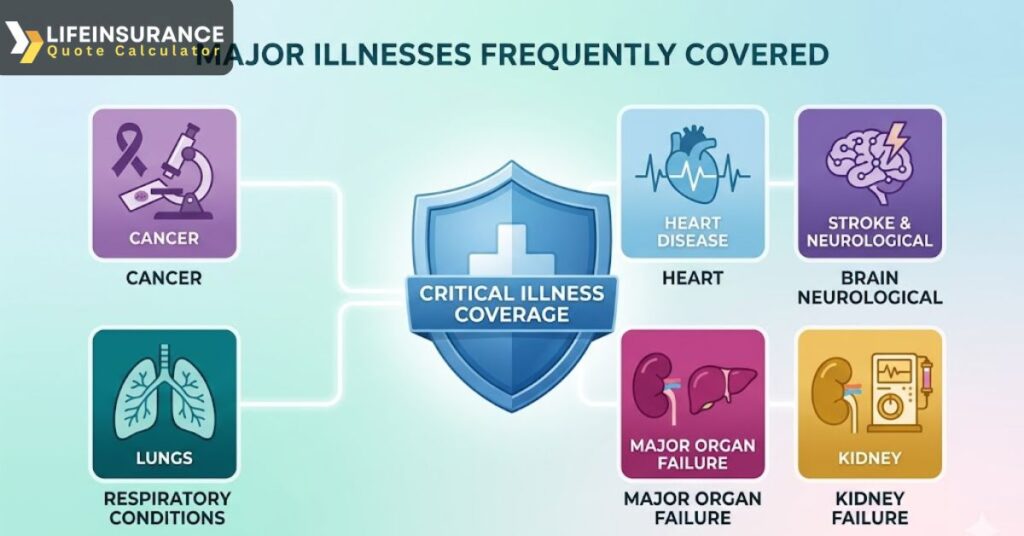
The coverage varies by insurance company but there are several serious illnesses that most policies include as standard. Cancer, heart attack and stroke are almost always on the list. Beyond those three the covered illness list can get pretty detailed depending on the insurer and the plan you choose.
List of Serious Illnesses Typically Covered Under This Rider
Most life insurance companies cover a core group of serious illnesses. These typically include heart attack, stroke, cancer, kidney failure, major organ transplant, coronary artery bypass surgery and paralysis. Some policies also include aorta surgery, blindness, deafness, speech loss and coma.
The exact list depends on your insurance company so you want to read the policy documents carefully. An insurance agent can walk you through which specific illnesses are covered under the plan you are considering.
What Are the 36 Critical Illnesses That Life Insurance May Cover
Some insurance products in the US market cover up to 36 critical illnesses. This expanded list goes beyond the basic three and includes conditions like aplastic anemia, bacterial meningitis, benign brain tumor, cardiomyopathy, chronic liver disease, chronic lung disease, Crohns disease, encephalitis, Parkinsons disease and multiple sclerosis among others.
Not every insurance company offers coverage for all 36. Some plans offer a limited benefit for less severe conditions and a full payout for the most serious ones. If this level of critical illness coverage matters to you it is something to specifically ask about when you are reviewing insurance plans.
What Does a Critical Illness Rider Exclude
The rider does not cover everything. Pre existing conditions are often excluded especially if they were diagnosed before you added the rider to your life insurance policy. Some insurance companies also exclude illnesses caused by self inflicted harm, drug use or criminal activity.
There is also often a survival period clause. This means you have to survive for a certain number of days after your diagnosis typically 14 to 30 days before the payout is released. If the illness results in death before that period ends the critical illness benefit may not be paid out separately and only the standard life insurance death benefit would apply.
Covered vs Not Covered Conditions Under Critical Illness Rider
| Condition | Typically Covered | Notes |
|---|---|---|
| Heart Attack | Yes | One of the most commonly covered illnesses |
| Stroke | Yes | Included in nearly all plans |
| Cancer (life threatening) | Yes | Specific types may vary by policy |
| Kidney Failure | Yes | Usually included as a covered illness |
| Major Organ Transplant | Yes | Heart, liver, lung, kidney transplants |
| Paralysis | Yes | Full limb paralysis typically covered |
| Parkinson’s Disease | Sometimes | Depends on the insurer and plan tier |
| Pre existing Conditions | No | Usually excluded if diagnosed before adding rider |
| Self inflicted Harm | No | Excluded by virtually all insurance companies |
| Non critical illness | No | Must match specific illnesses listed in policy |
Critical Illness Rider vs Other Life Insurance Riders Full Comparison
There are several illness riders and benefit riders you can add to a life insurance policy. Each one works differently and covers different situations. Knowing the difference helps you build a policy that actually matches your real life needs.
Critical Illness Rider vs Chronic Illness Rider
A chronic illness rider pays out when you can no longer perform a certain number of daily living activities on your own things like bathing, dressing or eating. It is designed for people dealing with long term conditions that affect their daily function.
A critical illness rider on the other hand pays out based on a specific diagnosis. You do not have to prove functional impairment. You just need a confirmed diagnosis of a covered illness. The chronic illness rider cost and the critical illness rider cost can differ depending on the insurance company and your health profile.
Critical Illness Rider vs Terminal Illness Benefit
A terminal illness benefit also called a terminal illness rider pays out when a doctor certifies that you have a life expectancy of 12 to 24 months or less. It is an accelerated death benefit that lets you access funds while you are still alive but only when things have reached a very serious stage.
A critical illness rider can pay out much earlier in the process right after a qualifying diagnosis even if full recovery is expected. So the two riders serve different purposes and in some cases you might want both depending on your insurance needs.
Critical Illness Rider vs Long Term Care Rider
A long term care rider helps pay for nursing home care, in home care or assisted living when you need ongoing help with daily activities. It is a separate type of living benefit designed for extended care situations.
A critical illness rider is not meant to replace long term care rider coverage. It gives you a one time lump sum payout after diagnosis. A long term care rider typically pays ongoing benefits over time. If you are thinking about out of network care or extended medical support after a serious illness these two riders can actually work together.
Critical Illness Rider vs Waiver of Premium Rider
A waiver of premium rider keeps your life insurance policy active by waiving your premium payments if you become disabled or seriously ill and can no longer work. It does not give you cash but it protects your policy from lapsing.
A critical illness rider gives you actual cash after a diagnosis. The two riders solve different problems. Adding both to a life policy gives you stronger all around protection during a health crisis.
Critical Illness Rider vs Disability Rider Life Insurance
A disability rider life insurance option pays you a monthly income if you become disabled and cannot work. It replaces lost income over time. A critical illness rider pays a one time lump sum amount tied to your death benefit.
If your concern is income replacement after a serious illness a disability rider might fit better. If your concern is covering a sudden large medical expense or getting financial support right after diagnosis then a critical illness rider is the more direct solution.
Side by Side Rider Comparison
| Rider Type | Trigger Condition | Payout Type | Effect on Death Benefit | Best For |
|---|---|---|---|---|
| Critical Illness Rider | Diagnosis of covered illness | Lump sum | Reduced by payout amount | Sudden medical crisis |
| Chronic Illness Rider | Unable to perform daily activities | Periodic or lump sum | Reduced by payout amount | Long term conditions |
| Terminal Illness Rider | Life expectancy 12 24 months | Lump sum (accelerated) | Reduced by payout amount | End of life planning |
| Long Term Care Rider | Need for ongoing daily care | Monthly ongoing benefits | Reduced over time | Extended care expenses |
| Waiver of Premium Rider | Disability or serious illness | No cash waives premium | No change | Keeping policy active |
| Disability Rider | Disability preventing work | Monthly income | No change | Income replacement |
Critical Illness Rider Life Insurance Pros and Cons
No insurance product is perfect for everyone. The critical illness rider has real strengths and it also has some limits you need to know about before you add it to your policy.
Key Benefits of Adding a Critical Illness Rider to Your Life Policy
The biggest benefit is access to cash when you need it most. When a serious illness hits your household the last thing you want to worry about is money. The critical illness rider provides a lump sum payout that you can use however makes sense for your situation.
It is also more affordable than buying a standalone critical illness insurance plan in many cases. Adding this rider to an existing term life insurance or whole life insurance policy keeps your insurance coverage consolidated. And because the payout is not tied to specific medical bills you have real flexibility in how you use it.
Financial Relief When a Serious Illness Hits Your Household
A critical illness diagnosis does not just bring medical bills. It brings lost income, travel costs for treatment, home modifications and a dozen other expenses that health insurance plans do not always cover. The living benefit from a critical illness rider fills those gaps.
The funds to help cover those extra costs come directly to you as a lump sum. You can use them to pay for medical treatment, supplement lost wages, cover household bills or pay for out of network care that your health plan will not touch. That kind of financial support is something a lot of families wish they had planned for earlier.
Flexibility in Spending the Critical Illness Benefit
The critical illness benefit does not come with spending restrictions in most cases. You are not required to use it only for medical expenses. You can pay rent, clear debt, fund a family trip or just keep it in savings as a buffer. That flexibility is one of the things that makes this rider genuinely useful rather than just a checkbox on a policy.
Potential Drawbacks You Should Know Before Adding This Rider
The rider might not cover every illness you are thinking about. Coverage is limited to specific illnesses listed in the policy and that list can be shorter than you expect. Some insurance companies also apply a survival period before releasing the benefit amount.
Adding this rider also increases your premium. It is not a huge jump in most cases but it is still an added cost. And when you do use the rider your death benefit will be reduced which means your beneficiaries get less. That trade off is worth thinking through carefully.
How Pre Existing Conditions Affect Your Eligibility for This Rider
This is where things get tricky for some people. If you already have a health condition before applying the insurance company might exclude that condition from your critical illness coverage. In some cases a medical exam is required to determine eligibility.
That said having a pre existing condition does not automatically disqualify you. Some insurance products are designed with more flexible underwriting. A qualified insurance professional can help you find a plan that works even if your health history is not perfect. The key is being upfront with the insurance company from the start.
Critical Illness Rider Life Insurance Cost What Affects What You Pay
There is no single number that applies to everyone. The cost of adding a critical illness rider to your life insurance policy depends on several personal factors and policy choices.
Age, Health Rating and Coverage Amount as Pricing Factors
Your age at the time of application is one of the biggest factors. The younger you are the lower the rider cost tends to be. Your health classification whether you are rated Preferred Plus, Standard or somewhere in between also plays a major role.
The benefit amount you choose matters too. A rider that provides a larger payout will cost more than one with a limited benefit. And the type of life insurance you are adding it to whether it is term life insurance or universal life or whole life insurance affects the overall cost as well.
Chronic Illness Rider Cost vs Critical Illness Rider Cost
These two riders are often compared because they both deal with serious health situations. In general a chronic illness rider cost can be higher because it covers ongoing long term conditions that may require extended payouts. A critical illness rider typically involves a one time lump sum so the cost structure is different.
That said the pricing varies quite a bit between insurance companies. Getting a life insurance quote that includes both rider options side by side is the best way to make a real comparison for your specific situation.
Is a Critical Illness Add On Worth the Extra Premium
For most families yes it is. One serious illness can wipe out savings, disrupt income and create financial pressure that lasts for years. The extra amount you pay each month for this rider is small compared to the financial support it can provide if you ever need it.
That said it depends on your situation. If you already have solid health insurance plans and a strong emergency fund the need may be lower. But for most working adults in the US who are carrying a mortgage, raising kids and living paycheck to paycheck this rider can be a genuinely smart addition to a life policy.
Factors That Affect Critical Illness Rider Cost
| Factor | How It Affects Your Cost |
|---|---|
| Age at Application | Younger applicants pay less cost rises with age |
| Health Classification | Preferred Plus gets lower rates Standard pays more |
| Benefit Amount Selected | Higher payout = higher rider premium |
| Policy Type | Term life riders tend to cost less than whole or universal life riders |
| Smoking Status | Smokers pay significantly more across all rider types |
| Number of Covered Illnesses | More illnesses covered = higher cost for the rider |
| Waiting Period Length | Shorter waiting periods may increase rider cost |
Critical Illness Rider Life Insurance Payout How Much Can You Actually Receive
The payout amount depends on how the rider is structured in your policy. Some riders pay a flat dollar amount. Others pay a percentage of your total death benefit typically anywhere from 25 percent to 100 percent depending on the illness and the insurance company.
How Payout Amounts Are Calculated as a Percentage of Death Benefit
When a critical illness rider is added to your policy the insurance company sets a maximum benefit amount often tied to a percentage of the life insurance death benefit. For example if your policy has a death benefit of five hundred thousand dollars and the rider covers up to 75 percent you could receive up to three hundred seventy five thousand dollars upon a qualifying diagnosis.
Some policies have a tiered structure where less severe conditions receive a smaller percentage of the benefit and more serious ones trigger a full payout. Your insurance agent should be able to walk you through exactly how your specific plan calculates this.
Can You Use the Payout for Non Medical Expenses
Yes. In most cases the critical illness benefit payout is yours to use however you need. You can use it to help cover medical bills, pay for in home care, replace lost income or handle any other financial pressure that comes with a serious illness diagnosis. There is no requirement to use it only for healthcare.
This is one of the things that separates a critical illness rider from traditional health insurance plans. Health insurance covers specific medical services. The critical illness benefit covers your life whatever part of it needs the most support at that moment.
Is the Critical Illness Rider Payout Taxable
In most cases the payout from a critical illness rider is not taxable at the federal level in the US. Because it is structured as an accelerated benefit the IRS generally treats it the same way it treats life insurance death benefits meaning it is not counted as taxable income.
That said tax rules can change and individual situations vary. It is always a good idea to speak with a financial professional about the tax implications of any insurance benefits you receive. Do not rely solely on what the insurance company tells you get an independent opinion too.
Who Should Add a Critical Illness Rider to Their Life Insurance Policy
Not everyone needs this rider but a lot more people could benefit from it than realize it. If you are the primary earner in your household, if you have a family history of serious illness or if your health insurance plans have high deductibles and limited coverage this rider deserves serious attention.
Is This Rider the Right Fit If You Already Have a Medical Plan
Having a good medical plan at work does not make this rider unnecessary. Health insurance pays doctors and hospitals. It does not replace your lost income, cover your mortgage while you are in recovery or pay for non medical expenses that pile up during a serious illness.
A critical illness rider fills the gaps that health insurance plans leave behind. The two types of coverage work alongside each other rather than replacing each other. So yes even if you have solid health insurance adding a critical illness rider to your life insurance policy can still make real sense.
Are Critical Illness Riders Available for Children
Some insurance companies do offer critical illness riders for children as part of a parent’s life insurance policy. These child riders typically cover serious illnesses like cancer, organ transplants and certain heart conditions. The benefit amount tends to be lower than adult coverage but the protection is real.
If you are a parent and your insurance provider offers this option it is worth asking about. A serious illness in a child creates the same kind of financial pressure as one in an adult and having a living benefit rider in place can make a hard situation more manageable.
Best Life Insurance Riders in 2026 Where Critical Illness Ranks
In 2026 the critical illness rider continues to be one of the most requested add ons to life insurance policies across the US. People are more aware than ever of how expensive a serious illness can be even with health insurance and they are looking for ways to protect their finances before a crisis happens.
Alongside the chronic illness rider, the terminal illness benefit and the waiver of premium rider the critical illness rider rounds out a strong set of living benefit options. For most people looking to build a well rounded life policy it belongs near the top of the list.
How to Add a Critical Illness Rider to Your Life Insurance Policy
Adding this rider is usually straightforward. When you are applying for a new life insurance policy you simply ask about available riders and tell the insurance agent you want to include a critical illness rider. The insurance company will review your application and health information and let you know if you qualify.
Can You Add This Rider After Buying a Life Insurance Policy
In some cases yes. Certain insurance companies allow you to add a critical illness rider after the policy is already in force but this is not always available and it often requires additional underwriting. Some insurers only allow riders to be added at the time of original application.
If you already have a life insurance policy and you want to add a critical illness rider the best first step is to contact your insurance agent or the insurance company directly. They can tell you whether it is possible and what the process looks like for your specific plan.
What Happens to the Rider If the Policy Lapses
If your life insurance policy lapses meaning you stop paying premiums and the policy is no longer active the critical illness rider lapses along with it. The rider is not a standalone product. It lives inside your life insurance policy and it cannot survive without it.
This is one reason why a waiver of premium rider can be a smart companion to a critical illness rider. If a serious illness prevents you from working and paying premiums the waiver of premium rider keeps the policy active so you do not lose your critical illness coverage at the worst possible time.
How to Use a Life Insurance Quote Calculator to Compare Rider Options
Before you commit to any policy or rider it helps to run the numbers. A life insurance quote calculator lets you see how different coverage levels and rider combinations affect your monthly premium. You can compare term life insurance with and without a critical illness rider and see exactly what the difference looks like.
The Life Insurance Quote Calculator at lifeinsurancequotecalculator.com makes this easy. You enter your age, health status and coverage amount and you get a real estimate in under two minutes. No phone number required and no sales pressure. It is a practical starting point for anyone who wants to make an informed decision about their insurance coverage and the riders that come with it.
Frequently Asked Questions About Critical Illness Rider Life Insurance
1. What is a critical illness rider in life insurance
A critical illness rider life insurance is an add on that pays cash if you get a serious illness. It sits on your base policy. Think of it like a living benefits rider life insurance that helps while you are still alive.
2. What does a critical illness rider cover
Coverage usually includes cancer heart attack and stroke. Some plans also include organ failure. The critical illness rider life insurance gives a lump sum that you can use for bills or recovery.
3. How does a critical illness rider work
You add it to your policy and pay a bit more. If you are diagnosed with a listed illness the insurer pays part of the death benefit early. That is why many call it an accelerated benefit rider.
4. Are critical illness riders worth it
For a lot of people it can help during a tough time. I have seen cases where that payout kept things stable. So yes critical illness rider life insurance can be worth it if you want extra protection.
5. Does life insurance cover critical illness
Basic policies usually do not. You need a life insurance critical illness add on to get that benefit. Without it the policy only pays after death.
6. What is life insurance with critical illness
It is a standard policy plus a rider. You get both death cover and illness support. Some plans also pair it with a disability rider life insurance or waiver of premium rider.
7. What critical illnesses are covered by a critical illness rider
Most plans list major illnesses like cancer stroke and heart disease. Some include kidney failure or major surgery. Always check the policy list since each company is a bit different.
8. Will a critical illness rider cover cancer
Yes in most cases cancer is covered. But the stage and type can matter. That is the part many people miss when picking a plan.
9. What is the difference between critical illness cover and life insurance
Life insurance pays after death. Critical illness rider life insurance pays while you are alive after diagnosis. So one protects family later and one supports you now.
10. What are the benefits of a critical illness rider
It gives fast cash support during illness. It helps with treatment cost lost income and daily needs. When I compare options in a life insurance rider comparison this one often stands out for real life use.
Get in Touch With Us
For any questions about critical illness rider life insurance or to get help comparing your options reach out to the team directly.
Office: 13th Analyze Street, New York, NY 10003
Phone: +1 (523) 235 0786
Email: info@lifeinsurancequotecalculator.com
Follow us on our Linkedin and Facebook!