
Table of Contents
Losing someone is hard. Then you remember there is a life insurance policy. And now you have to deal with the life insurance claim process. The truth is most people have no idea how to file a life insurance claim. That is normal. You are not supposed to know this stuff until you need it.
Here is the plain truth. The life insurance claim process does not have to be a nightmare. Insurance companies pay billions in death benefit every year. They expect to pay your claim. You just have to follow the right steps.
This guide walks you through how to file life insurance claim from start to finish. You will learn about life insurance claim documents needed and how long does life insurance claim take. Plus we cover life insurance claim denied reasons and even life insurance payout real stories so you know what actually happens. Let us get started.
What Is the Life Insurance Claim Process?
Life insurance claim definition and basic steps
A life insurance claim is a formal request a beneficiary makes to an insurance company to receive the death benefit after the insured passes away. That is it. Nothing more complicated than that. The claims process involves a few basic things. You notify the life insurance company. You submit paperwork.
You wait for claim review. Then you get your payment. For a lot of people this whole thing takes two to four weeks. For some it takes longer. That depends on the cause of death and how old the insurance policies are.
Why beneficiaries delay filing and why that costs them
Some people wait to file a claim. They are grieving. They do not want to deal with paperwork. Or they lost the policy. Here is the thing. The life insurance death claim process USA has no time limit in most states. But waiting does not help you.
Insurance companies do not pay interest on money they hold. Every day you wait is a day your family does not have that cash. So call your insurer as soon as you can. Get the packet started. You can grieve and do paperwork at the same time.

How to File a Life Insurance Claim Step by Step
Step 1 – Find the original life insurance policy documents
You need the policy number. This is the fastest way for the claims department to find the insured’s file. Check the safe deposit box. Look through filing cabinets. Ask the policyholder’s employer if it was a work policy.
Lost everything? Do not panic. The life insurance company can find the policy using the insured’s full name date of birth and Social Security number. But having that policy number speeds things up by a lot.
Step 2 – Get certified copies of the death certificate
You cannot file a life insurance claim without a death certificate. Most insurance companies want a certified copy. Not a photocopy. Not a hospital printout.
Order at least 10 certified copies from the county vital records office. Each one costs around 15 to 25 dollars. You will need extra copies for banks credit cards and the mortgage company anyway. The claims team keeps the copy. They do not mail it back.
Step 3 – Contact the life insurance company directly
Find the phone number or website for the life insurance company. Call them. Tell them the insured passed away. Ask to submit a life insurance claim. They will ask for basic info like the insured’s full name date of birth and policy number if you have it.
Some companies like MetLife let you start online. Others want a phone call first. Either way you need to notify them. Do not assume they know. They do not get automatic alerts when someone dies.
Step 4 – Complete the life insurance claim form
The insurer will send you a claim form. They might mail it or let you download it via email or their website. This form asks for basic information about you the beneficiary and the insured.
You will need to state the cause of death. Be honest. The insurance company will check medical records especially if death happened within the first two years of the policy. Lying on the claim form is a fast way to get denied.
Step 5 – Submit all life insurance claim documents needed
Submit your complete the claim packet together. This usually includes:
- The completed claim form
- A certified death certificate
- Copy of the insured’s ID
- Your ID as the beneficiary
- The original policy if you have it
Send everything via email or regular mail. Some companies let you upload documents online. Keep copies of everything you send. Use certified mail if you send physical paperwork. That way you can prove they got it.
Life Insurance Claim Documents Needed for a Smooth Payout
Required paperwork for any life insurance death claim
Every insurance claim needs the same basic documents. Here is the list. A certified death certificate from the state. The official claim form from the life insurance company. Proof of identity for every person named on the policy as beneficiary. And the policy number or the original policy document if available. Missing one of these delays the process of filing. So double check before you send anything out.
Supporting documents for disputed life insurance claims
Not every claim is simple. If the insured died within the first two years the claims department might ask for medical records. They want to see if the insured lied on the application. Things like smoking or a pre existing heart condition matter here.
If the cause of death is a car crash you might need a police report. If it is a work accident you might need an autopsy report. Send whatever they ask for quickly. That stops the clock on claim review.
What happens if you lose the original policy
Losing the policy feels scary. But it is not a disaster. The life insurance company has a record. You just need to give them enough information to find it. That means the insured’s full name date of birth Social Security number and last known address.
Once they find the policy they send you the claim form like normal. The only difference is you cannot see the death benefit amount before you file. But that does not stop the life insurance claims process.
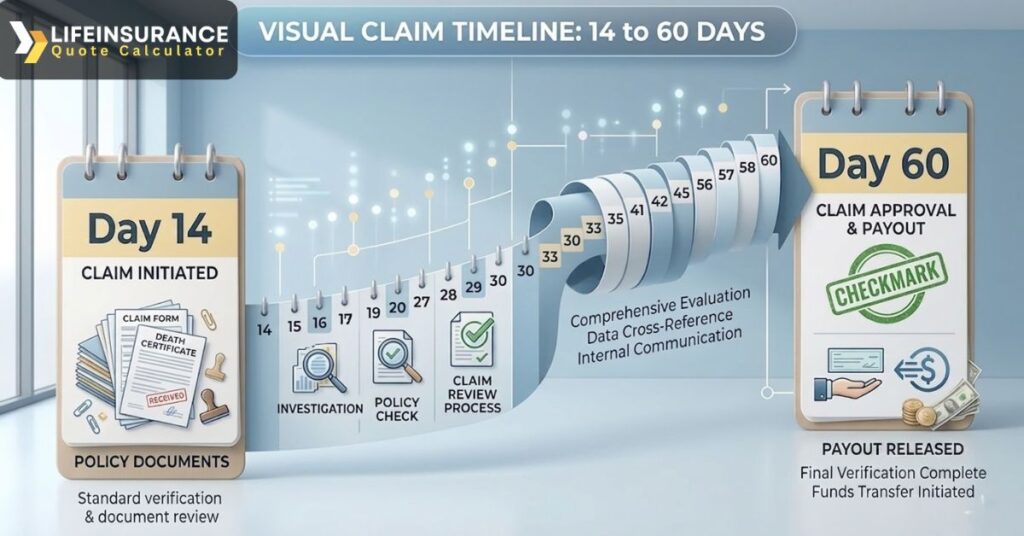
Life Insurance Claim Timeline – How Long Does a Life Insurance Claim Take
Standard claim review time: 14 to 60 days
Most insurance companies pay within 30 business days after you submit all the paperwork. For example MetLife life insurance claims payout time averages 14 to 21 days for clean claims. MetLife life insurance claims payout chart data shows simple term policies pay fastest.
The clock starts when the claims department has everything. Not when you first called. So send your documents complete the first time.
How long does a life insurance claim take for non contestable policies
A non contestable policy means the insured died more than two years after buying it. These claims move fast. The insurer cannot argue about mistakes on the application after two years in most states. For these policies how long does life insurance claim take drops to 10 to 20 days. The claim review only checks that the beneficiary is right and the death certificate is real. Then they pay the claim.
Life insurance claim process after death when death occurs within first two years
This is the contestable period. If the insured dies in the first two years the life insurance company investigates. They pull medical records. They call doctors. They check the application answers against real health history. How long does life insurance claim take in this situation? Usually 45 to 90 days. Some disputed life insurance claims take even longer. But most still pay. They just need to do their homework.
Life Insurance Claim Denied Reasons and How to Fight Back
Material misrepresentation on the original application
This is the most common life insurance claim denied reasons. The insured said they did not smoke. But medical records show they did. Or they said they had no heart problems. But their doctor had notes about high blood pressure. The insurer can deny the claim and refund premiums paid. That is legal. That is in the contract. The only way around this is if death was completely unrelated to the lie. A smoker dying in a car crash might still get paid.
Suicide clause life insurance – the two year rule
Nearly every policy has a suicide clause life insurance provision. Here is how it works. If the insured dies by suicide within the first two years the insurance company does not pay the death benefit. They refund the premiums paid. After two years suicide clause life insurance no longer applies. The policy pays the full death benefit. No questions asked about cause of death. That is standard for every major life insurance company.
Lapsed policy due to missed premium payments
This one hurts. The insured stopped paying premiums. The policy lapsed. The family thought coverage was still active. But it was not. Check the policy carefully. Some policies have a grace period of 30 or 60 days. If death happened inside that window the insurer still pays. But if the policy lapsed months ago there is no payment.
How to appeal disputed life insurance claims
Disputed life insurance claims are not the end. You can appeal. Write a formal letter to the claims department. Ask for the exact reason for denial. Request copies of any medical records they used. Then hire a lawyer who specializes in life insurance beneficiary claim denials. Many work on contingency. That means they get paid only if you win. Appeals can take months but they work for a lot of people.
Life Insurance Beneficiary Claim – Who Gets the Death Benefit
Primary versus contingent life insurance beneficiary explained
The primary beneficiary is first in line. That is usually a spouse or a child. If the primary beneficiary is alive they get 100% of the proceeds. The contingent beneficiary gets paid only if the primary beneficiary dies before the insured. No splitting. No sharing. One or the other.
How to collect life insurance as a beneficiary with no will
Good news. A will does not matter for life insurance. The policyholder already named on the policy who gets the money. That overrides any will. So you do not need to wait for probate court. The beneficiary just needs to complete the claim process. The insurance company sends the check directly to you. No judge needed. No lawyer required.
Multiple beneficiaries – split payments and disputed life insurance claims
If two people are named on the policy as primary beneficiaries they split the death benefit 50/50 unless the policy says otherwise. Each person files their own claim form. Each gets their own check.
Problems happen when one beneficiary cannot be found. The insurer might hold the missing person share for years. That is one reason disputed life insurance claims get messy. Stay in touch with the insurance company so they can receive your claim without delays.
Life Insurance Payout Real Stories from Actual Beneficiaries
Life insurance payout real stories – the smooth claim
A woman in Ohio lost her husband suddenly. Heart attack at age 52. He had a 250 thousand dollar term policy. She called the life insurance company the next day. She sent the death certificate and claim form within a week.
The claims team paid 22 days later. No headaches. No denials. No doctor exams. That is the most common outcome. People just do not talk about it because easy claims are boring.
Life insurance payout real stories – the delayed claim
A family in Texas waited four months for a payout. Why? The insured died while traveling overseas. The cause of death was unclear. The insurance company wanted a foreign death certificate translated. Then they wanted an autopsy report.
The family had to call your insurance company every week. They learned that how long does life insurance claim take changes fast when international paperwork gets involved. They got paid eventually. But it was not fast.
Life insurance payout real stories – denied then paid on appeal
A man in Florida had a 500 thousand dollar policy. He died from liver failure two years and one month after buying the policy. The insurer denied the claim. They said he lied about drinking on the application.
His widow appealed. She found doctor notes showing he stopped drinking five years before the application. The claims department reversed the denial. She got the full payment seven months after he died. She almost gave up. But she did not.
Suicide Clause Life Insurance – What Every Policy Owner Should Know
Suicide clause life insurance standard two year period
Every term life and whole life policy includes this. For the first two years the insurer does not pay for suicide. After two years they pay the full death benefit no matter what. Why do insurance companies do this? It stops someone from buying a policy today and ending their life tomorrow. The two year wait makes that plan fail.
Suicide clause life insurance – what beneficiaries get if death happens early
If the insured dies by suicide within the first two years the beneficiary does not walk away with nothing. The life insurance company refunds every premium the insured paid. That is not the full death benefit but it is something.
For a 500 thousand dollar policy with two years of premiums paid at 50 dollars a month that refund is about 1200 dollars. Not what you hoped for. But it is honest.
States with modified suicide clause life insurance laws
Most states use the two year rule. A few states like Colorado and North Dakota have different time periods. Missouri has a one year suicide clause for some policies. Check your policy or ask the claims department directly. The life insurance death claim process USA varies a little by state. But two years is the national standard for most insurance policies.
How to Check Life Insurance Claim Status Without Losing Your Mind
MetLife claim status online portal walkthrough
MetLife has an online portal. You can check MetLife claim status online any time of day. You need the claim number they gave you when you first called. Log in. Look for the claims section. It shows if they are waiting on documents or if claim review is done. Other insurance companies have similar tools. Search for claim status on their website. Register as a beneficiary to see updates without calling anyone.
Phone and email follow up scripts for beneficiaries
Call the claims department every two weeks if you see no movement. Say this: Hello my name is [your name]. I am the beneficiary for [insured’s name]. My claim number is [number]. Can you tell me if you need any additional information from me?
Email or mail works too. Put the claim number in the subject line. Keep a log of who you talked to and what they said. That paper trail helps if you need to complain later.
What to do if the life insurance company delays beyond 60 days
Most states have a insurance department. You can file a complaint. The department will ask the insurer why they have not paid. That often speeds things up. Also ask the claims team for a supervisor. Regular phone agents cannot fix long delays. Supervisors can. Be polite but be firm. You are owed that death benefit.
Frequently Asked Questions
1. How long does it usually take to process a life insurance claim?
Most life insurance claim process timelines run 14 to 60 days. Simple claims with clean paperwork often pay in two to three weeks. Claims that need extra review like deaths within the first two years can take 45 to 90 days. How long does a life insurance claim take really depends on the cause of death and if the policy is contestable.
2. What two items are required for a life insurance claim?
You need a certified death certificate and a completed claim form from the insurance company. Thats it for the basics. The life insurance claim documents needed can grow from there but those two start everything. Without both the claims department won’t even begin your life insurance beneficiary claim.
3. How do I file a life insurance claim?
Call the life insurance company first. Get the claim form sent to you. Then submit the death certificate and the completed form via email or regular mail. The life insurance death claim process USA starts with that notification. I have helped three families through this and the phone call is always the hardest part. After that it is just paperwork.
4. What happens after filing a claim?
The claims team reviews your paperwork. They verify the beneficiary and the cause of death. Then they either approve payment or ask for additional information. Disputed life insurance claims go through a longer claim review. Most claims just move to the payment stage without any drama.
5. What information do I need to file a claim?
You need the insured’s full name date of birth and Social Security number. You also need your own ID as the beneficiary. The policy number helps a lot but the insurer can find the policy without it. How to file life insurance claim becomes much faster when you have that policy number ready before you call.
6. If there are multiple beneficiaries how will we get paid?
Each beneficiary named on the policy gets their own share. The insurance company splits the death benefit according to the percentages listed in the policy. Each person files their own claim form. Each gets their own check. That includes primary and contingent beneficiary arrangements.
7. Will life insurance payout affect SSDI?
No. The death benefit from life insurance does not count as income for Social Security Disability Insurance. SSDI looks at earned wages not insurance proceeds. So that payment will not reduce or cancel your SSDI benefits. Go ahead and receive your claim without worrying about that.
8. What is the 10000 death benefit?
A 10000 death benefit is a small life insurance policy. People often get these through work or as a final expense plan. The life insurance claim process works the same way as larger policies. You still need a death certificate and a claim form. The only difference is the check size.
9. Are there additional requirements if the beneficiary is a trust?
Yes. The trust document must be valid and the trustee has to file the claim. The insurance company needs to see the trust paperwork including the page that names the trust as beneficiary. This is one of those life insurance beneficiary claim situations where extra documents are required. A lawyer can help if the trust language is tricky.
10. Does life insurance really pay out?
Yes. Insurance companies paid over 90 billion dollars in death benefit claims last year. Life insurance payout real stories show that valid claims get paid. The suicide clause life insurance rule only applies in the first two years. Life insurance claim denied reasons exist but they are not the norm. For most families the claims process ends with a check.
Life Insurance Claim Process Final Checklist Before You Submit
Getting ready to submit your claim? Run through this list one more time.
Do you have a certified death certificate? Did you complete the claim form with no blank spaces? Did you include the policy number? Make copies then send it via email or certified mail.
Do that list then breathe. The insurance company has handled thousands of claims just like yours and they will handle yours too.
If you need help call the claims department and ask for the beneficiary support team. They are there to help you receive your claim as fast as the law allows.
Contact Us