
Life insurance costs $18 to $160 per month for most Americans. That is far less than most families expect.
Many people skip coverage because they assume the monthly cost is out of reach. It is not. A healthy 30-year-old can get $500,000 in coverage for around $25 per month.
Use our life insurance premium calculator to see your exact rate in under 2 minutes.
This guide covers average life insurance rates by age and coverage amount, the difference between term life and whole life costs, what pushes your premium up or down, common buying mistakes, and how to get the lowest rate possible.
Table of Contents
Life insurance costs between $18 and $160 per month for most Americans. A healthy 30-year-old non-smoker pays roughly $20 to $30 per month for $500,000 in term life coverage. Whole life insurance costs significantly more. Your exact monthly premium depends on your age, health, coverage amount, policy type, and the insurer you choose.
What Is the Average Life Insurance Cost Per Month?
Most Americans pay $20 to $50 per month for term life insurance. That is the most affordable type of life insurance policy and the one most families buy.
Whole life insurance runs 5 to 15 times higher. The extra cost comes from two things: the policy never expires, and it builds cash value over time.
Here is the number that surprises most shoppers. LIMRA research shows that Americans overestimate the cost of life insurance by nearly 3 times. Many people guess $200 or more per month. The real average monthly cost for a healthy adult is well under $50.
The table below shows average monthly term life premiums for a healthy, non-smoking applicant on a 20-year policy:
| Age | $250,000 | $500,000 | $1,000,000 | $500K Whole Life |
|---|---|---|---|---|
| 25 | $13–$18 | $18–$25 | $28–$40 | $150–$210 |
| 30 | $15–$20 | $20–$30 | $32–$48 | $170–$230 |
| 35 | $18–$28 | $28–$42 | $45–$65 | $200–$280 |
| 40 | $28–$45 | $42–$70 | $70–$110 | $260–$360 |
| 45 | $42–$70 | $65–$105 | $110–$170 | $340–$480 |
| 50 | $65–$105 | $100–$160 | $170–$260 | $450–$650 |
| 55 | $95–$150 | $150–$240 | $255–$400 | $600–$900 |
Estimates only. Actual rates depend on health, insurer, and policy type. Female rates are typically 10 to 15 percent lower.
A 10-year term costs less than the figures above. A 30-year term costs more. The rates shown are for 20-year policies, which most families choose.
Life Insurance Monthly Cost by Age
Age is the single biggest driver of your life insurance rate. Every year you get older, the insurer sees a higher statistical risk. That risk gets priced into your monthly premium.
The practical math: every year you wait to buy, your premium rises roughly 8 to 10 percent.
A $500,000 policy that costs $25 per month at 30 will cost around $65 per month at 40. By 50, that same coverage runs $100 to $160 per month. Waiting a decade costs you a lot more money over the life of the policy.
Life Insurance Rates for Your 20s and 30s
This is your cheapest window. Life insurance rates are at their lowest when you are young and healthy.
A 30-year-old non-smoker pays around $20 to $30 per month for $500,000 in coverage on a 20-year term life policy. A 25-year-old pays even less, often under $20 per month for the same amount.
Many people in their 20s think they do not need coverage yet. But locking in a rate at 28 instead of 38 saves thousands of dollars over the term. Life expectancy tables reward young buyers with permanently lower rates for the life of the policy.
A 20-year or 30-year term makes the most sense here. You lock in your current rate and keep it fixed for the entire term, no matter what happens to your health later.
Life Insurance Rates for Your 40s and 50s
The jump between your 30s and 40s is noticeable. A 40-year-old pays roughly double what a 30-year-old pays for the same $500,000 policy.
That said, coverage in your 40s is still very affordable for most people. $42 to $70 per month for $500,000 in term life coverage is not unreasonable for a family budget.
In your 50s, life insurance rates by age rise sharply. A 20-year term may not be available at every insurer past age 55. Shorter terms and smaller coverage amounts become the more common choice. Life expectancy goes down, and premiums reflect that.
If you are in your 50s and have not bought coverage yet, act now. Waiting another year does not help you. Use our term life insurance calculator to see what your rate looks like today.
Term Life vs Whole Life Insurance Cost Per Month
The cost difference between term life and whole life is dramatic. Knowing which one fits your situation saves you from overpaying every single month.
Term life insurance covers you for a fixed period: 10, 20, or 30 years. If you die during the term, your beneficiary receives the death benefit. When the term ends, coverage stops. There is no cash value. No return of premiums. That simplicity is exactly why term life insurance is generally the most affordable option.
Whole life insurance is permanent coverage. It never expires. It also includes a cash value component that grows over time. You can borrow against that value or surrender the policy for its accumulated worth. That permanence costs money. A lot of it.
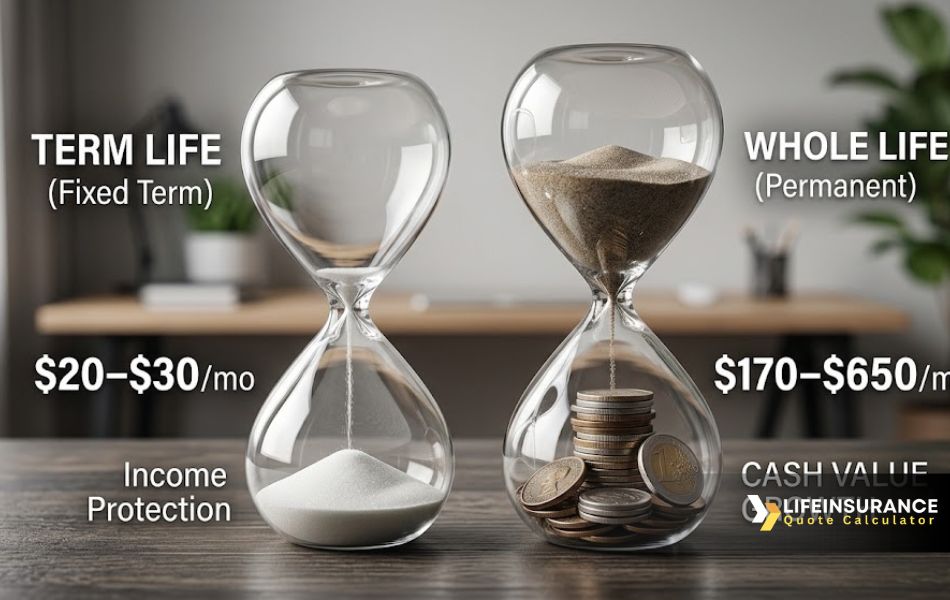
Here is a direct cost comparison at common ages:
| Age | $500K Term (20-yr) | $500K Whole Life |
|---|---|---|
| 30 | $20–$30/mo | $170–$230/mo |
| 40 | $42–$70/mo | $260–$360/mo |
| 50 | $100–$160/mo | $450–$650/mo |
Rates from major carriers including Northwestern Mutual, New York Life, and Prudential. Estimates only. Rates vary by insurer.
For most families, term life is the right answer. You get the maximum death benefit at the lowest monthly cost during the years your family depends on your income.
When Does Whole Life Insurance Make Financial Sense?
Whole life and universal life policies make sense in specific situations. They are not for everyone.
Consider permanent life insurance if:
- You have a lifelong dependent, such as a child with a disability
- You want to leave a guaranteed inheritance regardless of when you die
- You are using life insurance as part of an estate planning strategy
- You have maxed out all other tax-advantaged savings accounts
Outside of those situations, the higher monthly cost of whole life policies is hard to justify for average families. See our term vs whole life insurance guide for a full breakdown.
What Factors Affect the Cost of Life Insurance?
Your monthly premium is not random. Every insurer uses a process called underwriting to evaluate your individual risk before setting your rate. Underwriting means they assess how likely you are to make a claim.
These are the factors that directly impact your life insurance premium:
- Age — The most important factor. Rates rise every single year.
- Gender — Women have longer life expectancies. They pay roughly 10 to 15 percent less than men for identical coverage.
- Smoking status — Smokers pay 2 to 3 times the non-smoker rate. More on this below.
- Health history — Conditions like diabetes, heart disease, and prior cancer diagnoses affect both your eligibility and your rate.
- Coverage amount — More coverage means a higher premium. It scales roughly in proportion.
- Policy term length — A 30-year term costs more per month than a 10-year term for the same death benefit.
- Occupation — High-risk jobs such as truck driving, commercial fishing, and mining trigger higher rates.
- BMI and build — Height and weight outside standard ranges increase your premium.
- Family medical history — Parents or siblings with early-onset heart disease or cancer affects your risk classification.
- Driving record — Multiple serious violations or DUIs raise your rate.
Insurers place applicants into risk classes: Preferred Plus, Preferred, Standard Plus, Standard, and Substandard. Preferred Plus buyers get the best rates, often 25 to 40 percent lower than Standard class.
Understanding your likely risk class before you apply helps set realistic expectations. The life insurance underwriting process guide explains how insurers evaluate each factor in detail.
How Smoking Affects Your Monthly Life Insurance Rate
Smoking is one of the most expensive things you can do to your life insurance premium.
A policy that costs $30 per month for a non-smoker will cost $80 to $90 per month for a smoker with identical age, health, and coverage. That is two to three times more, every single month, for the same death benefit.
The good news: most insurers reclassify you as a non-smoker after 12 consecutive months without tobacco use. Quitting now, applying in 12 months, and comparing quotes from multiple life insurance companies can cut your monthly cost in half.
How Much Life Insurance Do You Actually Need?
Buying too little coverage is just as costly as overpaying on premiums. The wrong amount leaves your family exposed when they need protection most.
The common rule of thumb is 10 to 12 times your annual income. If you earn $70,000 per year, that points to $700,000 to $840,000 in coverage.
A more accurate method is the DIME formula:
- D: Debt — Total outstanding debts, not counting your mortgage
- I: Income — Annual income multiplied by the number of years until your youngest child is financially independent
- M: Mortgage — Remaining balance on your home loan
- E: Education — Estimated college costs for each child
Add those four numbers. That is your coverage target.
Real scenario: Marcus is a 38-year-old teacher in Texas. He earns $62,000 per year, has a $240,000 mortgage, $25,000 in car and student loans, two kids aged 6 and 9, and wants to cover 20 years of income. His DIME number comes out to roughly $1.3 million. A 20-year term policy at his age and health class runs about $55 to $75 per month. That is less than a cable bill for over a million dollars in family protection.
Do not guess at your number. Use our life insurance needs calculator to run your DIME calculation in under 2 minutes. Then check how much life insurance do I need for a full breakdown of coverage planning by family type.
Common Mistakes When Buying Life Insurance
Most people only think about buying life insurance after a major life event: a new baby, a home purchase, a health scare. By then, they have already missed years of lower rates.
These are the mistakes that cost people money and coverage:
- Waiting too long. Every year you delay, your rate goes up 8 to 10 percent. A 28-year-old who buys today pays far less over 20 years than a 35-year-old who buys the same policy later.
- Buying too little coverage. People often pick a round number like $250,000 without calculating what their family actually needs. Use the DIME method.
- Choosing whole life when term is enough. Whole life policies cost 5 to 15 times more per month. For most families buying life insurance for income protection, that extra cost does not add value.
- Getting only one quote. Rates for identical coverage can vary by 30 to 50 percent between insurers. Banner Life, Haven Life, and Protective Life often price very differently from larger carriers. Always compare.
- Forgetting to update the beneficiary. A life insurance policy with an outdated beneficiary goes to the wrong person. Review it after every major life change.
- Skipping coverage because you feel healthy. Good health right now is exactly why you should buy now. Your rate will never be lower than it is today.
Understanding what life insurance can do for your family, and what common traps to avoid, makes the buying process far less stressful. Learn more about how life insurance works before you apply.
Ways to Lower Your Life Insurance Premium
You cannot change your age. But several factors that directly affect the cost of life insurance are within your control.
1. Buy now, not later. Every year you wait costs you 8 to 10 percent more in premiums. A 30-year-old who locks in a 20-year term today pays significantly less over the life of the policy than a 35-year-old buying the same thing five years from now.
2. Choose term over whole life. Term life insurance is generally the most affordable life insurance option for pure income protection. Unless you have a specific permanent coverage need, whole life policies carry extra cost that most families do not need.
3. Pay annually instead of monthly. Most insurers charge a 3 to 5 percent fee for monthly billing. Paying one annual premium removes that fee and saves you money each year.
4. Improve your health before applying. Quitting smoking for 12 months moves you from smoker rates to non-smoker rates at most insurers. Losing weight, stabilizing blood pressure, and managing cholesterol can move you to a better risk class and lower your monthly cost.
5. Compare at least three insurers. Life insurance rates are based on individual carrier pricing models. Identical coverage can vary by 30 to 50 percent between companies. Never buy from the first quote you get.
6. Consider laddering two policies. Instead of one $1 million policy, buy a $500,000 10-year term and a $500,000 20-year term. You pay less in the early years when your obligations may be lower and still keep full coverage through your peak earning years.
7. Skip riders you do not need. Life insurance riders like accidental death benefit and return of premium add to your monthly cost. Only add a rider if it solves a specific problem in your situation.
Use our life insurance premium calculator to compare what different coverage amounts, term lengths, and policy types actually cost for your age and health profile.
How to Get a Life Insurance Quote in Under 5 Minutes
Getting a real quote is simpler than most people think. No phone call required.
1. Estimate your coverage amount. Use the DIME formula or run the numbers through a calculator. Most families need $500,000 to $1,000,000 in coverage.
2. Choose your policy type. Term life for most families. A 20-year term covers the years your dependents rely on your income most.
3. Use a calculator to see your premium range. Our life insurance premium calculator gives you a realistic estimate based on age, health, and coverage amount before you talk to anyone.
4. Compare quotes from multiple insurers. Rates vary significantly between life insurance companies. Comparing three to five insurers takes about 10 minutes and can save you hundreds of dollars per year.
5. Apply online. Most term life insurers offer fully online applications. Many use accelerated underwriting: no medical exam, decision within 24 to 48 hours.
Ready to start? Calculate your coverage needs here.
Use Our Calculator to Find Your Exact Monthly Cost
Finding the right coverage amount is the hardest part for most people.
You do not need to guess.
Use the life insurance calculator to enter your income, debts, and family size and get a personalized estimate in under 2 minutes.
Once you know your number, you can compare life insurance quotes from multiple insurers side by side.
Life insurance cost per month ranges from $18 to over $400 depending on policy type, age, health status, and coverage amount. Term life insurance is the most affordable option, with healthy 30-year-olds paying $20 to $30 per month for $500,000 in coverage on a 20-year policy. Whole life insurance costs 5 to 15 times more than term life but provides permanent coverage and builds cash value over time. Key factors that affect life insurance premiums include age, gender, smoking status, health history, coverage amount, and policy term length. Most Americans overestimate the cost of life insurance by nearly three times the actual rate, according to LIMRA research. Use a life insurance calculator to estimate your specific monthly premium based on your age and health.
Frequently Asked Questions About Life Insurance Cost Per Month
How much does life insurance cost per month on average?
Most Americans pay $20 to $50 per month for term life insurance. A healthy 30-year-old non-smoker pays around $20 to $30 per month for $500,000 in coverage. Whole life costs significantly more, typically $150 to $400 per month for comparable coverage. Your exact rate depends on age, health, and insurer. Use our life insurance premium calculator to get your specific estimate.
How much is life insurance per month for a 40-year-old?
A healthy 40-year-old non-smoker pays roughly $42 to $70 per month for $500,000 in 20-year term coverage. Women pay about 10 to 15 percent less. Smokers pay two to three times more. Whole life at 40 runs $260 to $360 per month or higher depending on the insurer and selected coverage amount.
How much does $500,000 in life insurance cost per month?
A $500,000 term life policy starts at $18 to $25 per month for a healthy 25-year-old. At 50, that same coverage runs $100 to $160 per month. Whole life for $500,000 ranges from $200 to $650 per month depending on age. Term life is the most cost-effective way to get $500,000 in coverage for most families.
How much does $1 million in life insurance cost per month?
A $1 million 20-year term policy costs $28 to $48 per month for a healthy 30-year-old. By 45, the same coverage runs $110 to $170 per month. Whole life insurance for $1 million can exceed $1,000 per month. For most families, term life is the most affordable path to $1 million in coverage.
What is the cheapest life insurance per month?
Term life is cheapest, starting under $20 per month for young healthy applicants. To get the lowest rate: buy young, choose a 10 or 20-year term, pay annually, stay healthy, and compare quotes from multiple life insurance companies. Independent brokers often find lower rates than going direct to a single insurer.
Does life insurance get more expensive as you age?
Yes. Premiums rise roughly 8 to 10 percent for every year you delay buying. A $500,000 policy costing $25 per month at 30 costs around $70 per month at 40 and $160 per month at 50. Locking in coverage at a younger age saves money over the full policy term. See how life insurance works for more detail.
Is life insurance worth the monthly cost?
For most families with dependents, a mortgage, or income others rely on, yes. A $500,000 term policy often costs less than $30 per month. The death benefit replaces years of income, covers mortgage payments, and funds childcare or education if the worst happens. The financial risk of no coverage far outweighs the monthly premium.
Can I get life insurance for under $20 a month?
Yes. Applicants in their 20s or early 30s in good health qualify for $250,000 to $500,000 in term coverage for $13 to $20 per month. Apply before age 35, be a non-smoker, have no major health conditions, and choose a 10 or 20-year term. Compare options at our term life insurance calculator.
How much life insurance does a 30-year-old need per month budget-wise?
Most 30-year-olds can get $500,000 to $1,000,000 in term life coverage for $20 to $48 per month. Use the DIME formula to calculate your exact coverage need. Our life insurance needs calculator runs that calculation automatically based on your income, debts, and family size.
Which type of life insurance policy has the lowest monthly cost?
A 10-year term life policy has the lowest monthly premium of any policy type. A healthy 35-year-old can get $500,000 in coverage for $18 to $25 per month on a 10-year term. That said, a 20-year term gives most families better long-term value by locking in low rates for a longer window of protection.
The Bottom Line
Life insurance is more affordable than most families think. Most people pay $20 to $50 per month for solid term life coverage. The three things that matter most: buy younger to lock in lower rates, choose term life for maximum value per dollar, and compare multiple insurers before you decide.
Do not guess what coverage costs for your age and health. Use our life insurance premium calculator. It is free, requires no phone number, and gives you a realistic estimate in under 2 minutes.
About the Author: Tahir Kaleem Naz is a life insurance content strategist with expertise in coverage planning and financial education for families. Connect on Facebook or LinkedIn.